
“Love your neighbor as yourself.”
You’ve probably heard this verse a thousand times, Mark 12:31, one of the greatest commandments. But the part we often skip over is : “as yourself.”
Jesus assumes you love yourself. He uses it as the standard for how you should love others. So if Jesus commands you to love your neighbor as yourself, that means biblical self love isn’t optional, it’s foundational.
Our culture has twisted self-love into self-obsession, narcissism, “you do you” and “your truth” and endless selfies with captions about how you’re your own #1. And Christians have responded by swinging to the other extreme: denying yourself means hating yourself. Humility means self-rejection. Loving yourself is selfish. But neither of these is biblical self love.
Let me show you what Mark 12:31 actually means, and what it doesn’t mean.
What Biblical Self Love Is NOT
Before we can understand what biblical self love is, we need to clear up what it’s not.
It’s Not Self-Obsession
Biblical self love is not:
- Making yourself the center of the universe
- Prioritizing your desires over God’s will
- Rejecting accountability or correction
- Living for your own glory
- Treating yourself as your own god
Instagram “self-love” says: “You’re perfect as you are. Don’t let anyone tell you otherwise.” That’s not biblical self love. That’s pride.
It’s Not Self-Rejection
But biblical self love also isn’t:
- Hating yourself because you’re a sinner
- Denying your needs as “selfish”
- Neglecting your body because “only spiritual things matter”
- Punishing yourself for every mistake
- Believing you’re worthless
Religious “humility” says: “You’re nothing. You’re worthless. Who are you to have needs?” That’s not biblical self love either. That’s self-contempt.
It’s the Balance
Biblical self love is the recognition that:
- You are made in the image of God (Genesis 1:27)
- You are deeply loved by God (John 3:16)
- You are worth caring for because God says so
- Your needs matter because God designed you with them
- Stewarding yourself well honors God
Biblical self love is stewarding the person God created you to be.
What Mark 12:31 Actually Says
Let’s look at the full context.
A scribe asks Jesus: “Which commandment is the most important?”
Jesus answers:
Mark 12:29-31: “Jesus answered him, “The first of all the commandments is: ‘Hear, O Israel, the Lord our God, the Lord is one. And you shall love the Lord your God with all your heart, with all your soul, with all your mind, and with all your strength.’ This is the first commandment. And the second, like it, is this: ‘You shall love your neighbor as yourself.’ There is no other commandment greater than these.”
Notice the order:
- Love God (with everything)
- Love your neighbor (as yourself)
Biblical self love is sandwiched between loving God and loving others.
“As Yourself”
Jesus doesn’t say: “Love your neighbor instead of yourself.” He says: “Love your neighbor as yourself.“
This assumes a baseline of healthy self-regard, an understanding that you have needs, that you’re worth caring for, that your wellbeing matters.
If you don’t love yourself, you can’t love your neighbor well.
Because you’ll either:
- Burn yourself out trying to prove your worth through service, or
- Become resentful because you’re constantly depleted
Neither of those is love.
What Jesus Assumes
Jesus assumes:
- You feed yourself when hungry
- You rest when tired
- You protect yourself from harm
- You take care of your basic needs
And He says: do that same thing for your neighbor. Biblical self love is the foundation for loving others well.
The Difference Between Selfish and Biblical Self Love
Here’s the key distinction:
Selfish self-love = I am the source and the goal
Biblical self-love = God is the source, others are the goal
Let me explain:
Selfish Self-Love:
- Source: “I define my worth. I am enough because I say so.”
- Goal: “I do what makes me happy. I prioritize my desires.”
- Focus: Me, me, me
- Result: Isolation, entitlement, pride
Biblical Self-Love:
- Source: “God defines my worth. I’m loved because He says so.”
- Goal: “I steward myself so I can serve God and love others well.”
- Focus: God first, then others (which includes caring for myself)
- Result: Wholeness, gratitude, humility
See the difference?
Selfish self-love makes you the center. Biblical self-love makes God the center, and recognizes that stewarding yourself honors Him.
Why You Can’t Pour From an Empty Cup
“You can’t pour from an empty cup.” You’ve heard that, right? And it’s true.
But let’s make it biblical: You can’t steward your calling if you destroy the vessel carrying it out. Your body is the temple of the Holy Spirit. (1 Corinthians 6:19-20) If you neglect your body, ignore your mental health, run yourself into the ground, and call it “dying to self,” you’re not being spiritual.
You’re being a poor steward.
The Parable of the Talents (Matthew 25:14-30)
A master gives three servants different amounts of money (talents) to steward while he’s away. Two servants invest and double what they were given. The master commends them: “Well done, good and faithful servant.” One servant buries his talent. The master calls him wicked and lazy.
Here’s the point: You’re responsible for stewarding what God gave you.
And part of what God gave you? Your body, your mind, your emotional capacity, your time, your energy…if you’re burying those, ignoring your needs, pushing past exhaustion, neglecting your health, you’re not being faithful.
You’re failing to steward what God entrusted to you.
Jesus Rested
Even Jesus, God in flesh, rested.
Mark 6:31: And He said to them, “Come aside by yourselves to a deserted place and rest a while.” For there were many coming and going, and they did not even have time to eat.
Jesus prioritized rest, even when people needed Him. If Jesus needed rest, you do too.
Ignoring your needs isn’t holiness. It’s pride.
Pride that says: “I’m above human limitations. I don’t need what God designed humans to need.”
What the Bible Says About Loving Yourself
Let’s look at specific scriptures about biblical self love:
Ephesians 5:28-29
“So husbands ought to love their own wives as their own bodies; he who loves his wife loves himself. For no one ever hated his own flesh, but nourishes and cherishes it, just as the Lord does the church.”
Paul assumes: you nourish and cherish your own body. That’s baseline. That’s expected. And he uses that as the standard for how you should love others.
Leviticus 19:18
“You shall not take vengeance, nor bear any grudge against the children of your people, but you shall love your neighbor as yourself: I am the Lord.”
Again: “as yourself.” God commands love for neighbor. But He assumes love for self.
Matthew 22:39
“And the second is like it: ‘You shall love your neighbor as yourself.’”
Jesus repeats it. This isn’t a one-time statement. It’s a principle. Loving yourself is assumed as the foundation for loving others.
1 Corinthians 6:19-20
“Or do you not know that your body is the temple of the Holy Spirit who is in you, whom you have from God, and you are not your own? For you were bought at a price; therefore glorify God in your body and in your spirit, which are God’s.”
Your body isn’t just “you.” It’s the dwelling place of the Holy Spirit.
Caring for your body = honoring God’s temple.
Neglecting your body dishonors God.
How to Practice Biblical Self Love
So what does biblical self love actually look like in practice?
Here are the key areas where biblical self love shows up:
1. Steward Your Body
Your body is the temple of the Holy Spirit. Biblical self love means caring for the physical body God gave you, not punishing it, not obsessing over it, but stewarding it well.
This includes how you move, rest, fuel, and listen to what your body needs.
Biblical Foundation:
1 Corinthians 6:19-20 – Your body is a temple
3 John 1:2 – Prosper in health as your soul prospers
2. Renew Your Mind
Your thought patterns shape your life. Biblical self love means guarding your mind and challenging the lies you believe about yourself.
This includes what you consume, how you talk to yourself, and whether you’re taking every thought captive to Christ.
Biblical Foundation:
Philippians 4:8 – Think on things that are true, honorable, just
Romans 12:2 – Be transformed by the renewal of your mind
2 Corinthians 10:5 – Take every thought captive
3. Know Your Identity
Your worth comes from God, not your performance. Biblical self love means knowing who you are in Christ, not who you wish you were, not who shame says you are.
This is the foundation of everything else. If you don’t know your identity, you can’t love yourself biblically.
Biblical Foundation:
John 1:12 – You are a child of God
Romans 8:1 – No condemnation for those in Christ
2 Corinthians 5:17 – You are a new creation
Ephesians 2:10 – You are His workmanship
But here’s the thing: Knowing these principles intellectually doesn’t mean you know how to live them out. You can read this blog and think, “Yes, that makes sense. I should do that.” But how do you actually steward your body when you’ve spent years punishing it?
How do you renew your mind when the lies feel more real than Scripture?
How do you receive your identity in Christ when you’ve built your worth on performance?
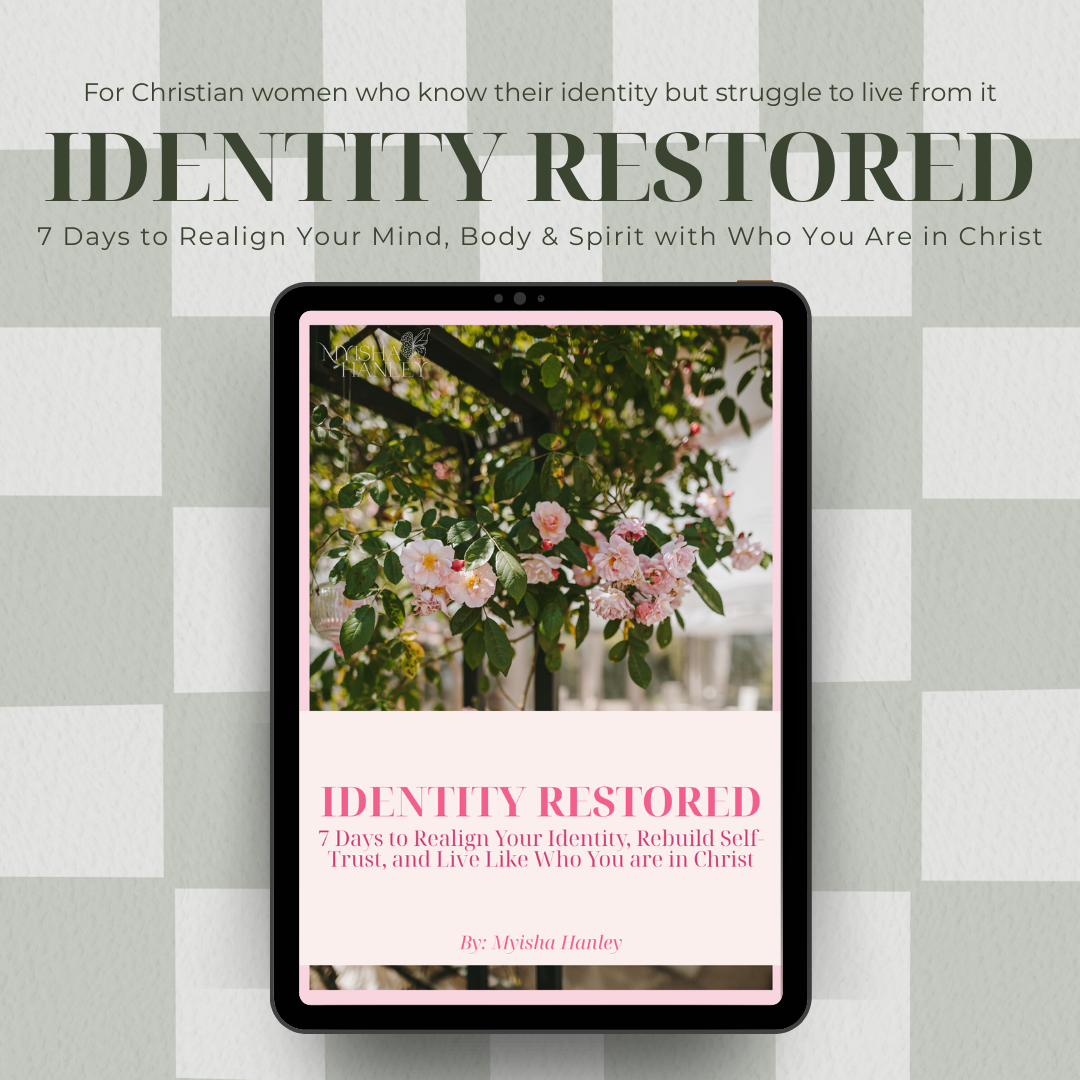
That’s exactly what Identity Restored does.
It’s a 7-day workbook that walks you through Scripture to rebuild your identity from the ground up, not on what you do, but on who God says you are.
Day by day, you work through the lies you’ve believed and replace them with biblical truth. Not just reading about it. Actually doing the work of restoration. Because biblical self love doesn’t happen by accident. It happens when you intentionally align what you believe with what God says.
When Self Love Becomes Self Obsession
Here’s how you know if you’ve crossed the line from biblical self love to selfish self-obsession:
Warning Signs:
❌ You justify sin as “self-care”
Biblical self love doesn’t excuse disobedience. If you’re calling sin “loving yourself,” that’s not biblical.
❌ You refuse correction
Proverbs 12:1 – “Whoever loves discipline loves knowledge, but he who hates reproof is stupid.” Biblical self love includes growth, which requires correction.
❌ Your needs always come first
Philippians 2:3-4 – “Do nothing from selfish ambition… but in humility count others more significant than yourselves.” Biblical self love makes space for sacrificial love.
❌ You’re unteachable
If you can’t receive feedback because “you’re perfect as you are,” that’s pride, not biblical self love.
❌ You prioritize comfort over obedience
Luke 9:23 – “If anyone would come after me, let him deny himself and take up his cross daily and follow me.” Biblical self love doesn’t eliminate sacrifice.
The Test:
Ask yourself:
- Is this helping me love God more?
- Is this helping me love others better?
- Is this stewarding what God gave me?
If yes → biblical self love.
If no → selfish self-obsession.
The Balance: Humble Confidence
Here’s what biblical self love produces:
Humble confidence.
Humble because:
- Your worth comes from God, not yourself
- You’re a sinner saved by grace
- You’re dependent on Him for everything
Confident because:
- God calls you His child
- You’re made in His image
- He says you’re worth caring for
You’re not the center. But you’re not worthless either.
You’re a beloved daughter of the King, entrusted with a life to steward well.
And stewarding yourself, your body, your mind, your spirit, honors Him.
Start Here: Know Who You Are
Biblical self love starts with knowing who you are in Christ.
Not who you wish you were.
Not who Instagram says you should be.
Not who your shame says you are.
Who God says you are.
And if you’re not sure who that is, that’s exactly where the Identity Restored workbook starts.
It’s a 7-day journey through Scripture to rebuild your identity from the ground up, not on performance, not on comparison, but on what God says about you.
Each day tackles a specific lie you’ve believed and replaces it with biblical truth. Not just reading it. Actually doing the work of identifying where the lie came from and how to walk in freedom from it.
You can’t love yourself biblically if you don’t know yourself truthfully.
The Invitation
You are not too selfish for caring about yourself. And you are not too broken to be loved. God made you. He loves you. And He’s calling you to steward the person He created. That includes your body. Your mind. Your needs. Your capacity.
When you love yourself the way God designed, when you steward yourself well, you’re positioned to love Him fully and love others sacrificially.
That’s biblical self love.
And it starts with knowing who you are in Christ.